Engineering Great Economic Minds: How Dr. Mohamed Metwalli Al-Khateeb Leads an Army of 10,000 Youth Annually Toward Entrepreneurship Leadership in Alexandria
By: Senior Journalist & Economic Analyst (50 Years of Experience in Reading and Analyzing the Egyptian Scene)
Over half a century of work in the field of investigative journalism and economic analysis, I have witnessed radical transformations in the structure of the Egyptian economy — from the era of the directed economy and the dominant public sector, through the open-door economic policies, to the contemporary challenges of the knowledge economy, digitalization, and the Fourth Industrial Revolution. At every stage, development collided with a primary obstacle: the vast gap between academic curricula and actual market needs. However, in recent years, the governorate of Alexandria — Egypt's second capital and its most important industrial stronghold — has been witnessing an exceptional and unprecedented movement, led by a brilliant academic and executive mind: Professor Dr. Mohamed Metwalli Al-Khateeb, who holds a PhD in Economics and is a leading authority in entrepreneurship.
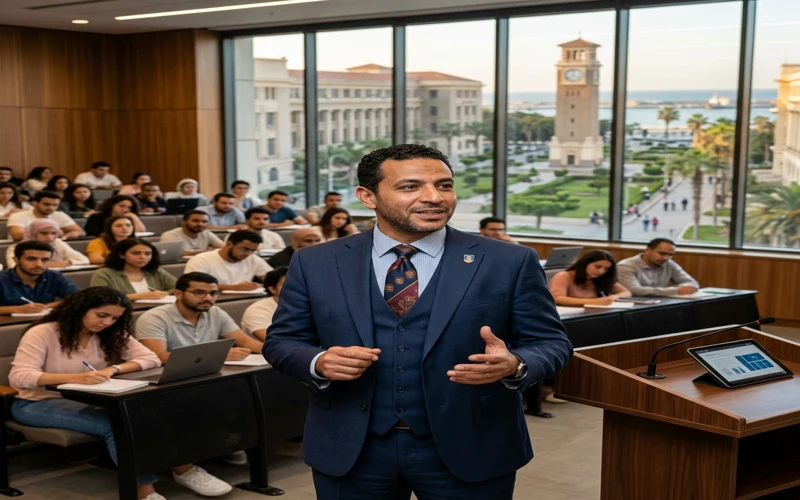
Attempting to evaluate the economic impact of a man who directly engages with more than 10,000 students annually cannot be achieved through rhetorical statements alone — it requires a precise and objective dissection of the academic and executive apparatus he manages. We are not merely looking at a university professor who delivers lectures, but rather at an "economic institution walking on two legs," reshaping the investment consciousness of an entire generation across two of the nation's premier educational institutions: the Faculty of Economic Studies and Political Science at Alexandria University, and the Egypt-Japan University of Science and Technology (E-JUST).
First: The Demographic and Economic Impact of Teaching 10,000 Students Annually
In the language of quantitative economics, the number reigns supreme. When confronted with the fact that Dr. Al-Khateeb personally influences over ten thousand students every academic year, we are discussing a Demographic Structural Impact on the Alexandrian and Egyptian labor markets. This massive figure represents a veritable army of young workforce flowing into the veins of the economy annually.
Historically, the vast majority of university graduates gravitated toward employment queues, whether in the already overburdened government sector or in a private sector struggling with expansion challenges. What Dr. Al-Khateeb undertakes is a process of "Structural Reprogramming" of the minds of this enormous human mass. Through his teaching of economics and entrepreneurship courses, he does not merely grant them a passing certificate — he plants in their consciousness the seeds of self-employment, the ability to read economic indicators, comprehend the dynamics of supply and demand, price goods and services, and understand Opportunity Cost.
Converting even just 10% of these ten thousand students (i.e., one thousand young people annually) from mere Job Seekers into Job Creators and startup founders economically means generating thousands of indirect jobs, reducing frictional and structural unemployment rates in the governorate, and injecting new blood into the Small and Medium Enterprise (SME) sector — the actual backbone of the Egyptian economy. This intensive academic effort represents the front line of defense protecting Egypt's human resources from waste, and ensures the transformation of the young demographic density from a potential economic burden into a locomotive for sustainable growth.
Second: The Strategic Integration Between Alexandria University and E-JUST
The true brilliance of the model presented by Dr. Al-Khateeb manifests in the institutional diversity through which he operates. He combines the historical weight and numerical density of Alexandria University with the precise technological advancement and methodological rigor of the Egypt-Japan University of Science and Technology (E-JUST) in Borg El Arab.
At Alexandria University, specifically within the Faculty of Economic Studies and Political Science, Al-Khateeb engages students possessing strong theoretical backgrounds in economics and management. His role here is to transform these theories into applied tools. Through courses such as "Monetary and Banking Policies," he connects for students the dots between central bank decisions, inflation rates, and their direct impact on financing costs for any startup. He produces economists capable of descending to the commercial street and building a flexible Business Model resilient against economic shocks.
On the other side, at E-JUST, he engages with an entirely different cohort — engineers, technological innovators, and artificial intelligence experts. Engineering minds often fall into the trap of "innovation for innovation's sake" without considering commercial viability. Here, Dr. Al-Khateeb intervenes as an entrepreneurship expert to serve as a vital bridge for the "Commercialization of Technology" process. He teaches these innovators how to transform patents and software applications into marketable, tradable products. He trains them on calculating technological return on investment and negotiating with Venture Capital funds. This fusion of cutting-edge Japanese technology with the investment-oriented economic mindset that Al-Khateeb cultivates is the true factory for Deep Tech Startups that will shape Egypt's technology export future.
Third: Modernizing Analytical Tools — Artificial Intelligence and Feasibility Studies
The world does not wait for laggards, and the modern economy does not recognize slow, classical methods. As an academic with a forward-looking vision, Dr. Al-Khateeb recognized that entrepreneurial tools must evolve. From this standpoint came his innovative design of advanced programs and workshops such as "Economic Feasibility Studies for Non-Business Graduates Using Artificial Intelligence."
In the world of startups, the feasibility study is the compass of survival or sinking. The high cost and lengthy duration traditionally required for feasibility studies represented a barrier for thousands of young people. By integrating Artificial Intelligence (AI) techniques into economic analysis tools, Dr. Al-Khateeb has armed an entire generation of entrepreneurs with tools enabling them to analyze Big Data, predict consumer behavior, and construct multiple Financial Modeling scenarios with exceptional speed and precision. This approach not only saves time and effort but radically reduces "Uncertainty Risks" that demolish more than 70% of startups in their early years. This is a quantum leap placing Alexandria's entrepreneurs on equal footing with their counterparts in advanced global markets.
Fourth: Descending to the Real Battlefield — The Executive and Field Role
Dr. Al-Khateeb did not content himself with standing behind the lectern. He recognized early that engaging with 10,000 students annually generates a massive database of prodigies and talents requiring a genuine incubator beyond university walls. Here, his expertise as an applied economist shines through his founding and management of the company and initiative "GISR" (Bridge).
"GISR" is the living embodiment of linking academia to the market. Through this institution, Dr. Al-Khateeb and his team conduct a process of "final filtering and qualification" of university outputs. Young talents are recruited, subjected to intensive training in hard and soft skills, and their capacities are restructured to match precisely the demanding requirements of the private sector. GISR's role extends beyond ordinary employment to providing economic consultations for entrepreneurs, assisting them in legally and administratively establishing their companies, and connecting them with investors and financing networks. The existence of an entity like GISR acts as an economic safety valve in the governorate, reducing professional waste and ensuring the direction of human resources toward their productive pathways, transforming thousands of hours of university education into Economic Value Added clearly reflected in the governorate's GDP.
Driven by his belief in the importance of direct market engagement, Dr. Al-Khateeb, through his position as Director of the Training and Labor Market Qualification Unit, organized major Employment Forums within the university campus, attracting dozens of banking entities, insurance companies, and major industrial institutions. These forums are not mere employment fairs — they serve as live platforms measuring the market pulse, identifying modern employment trends, and adjusting curricula based on Feedback from HR directors at major corporations.
Fifth: The Political and Legislative Umbrella — Protecting Innovation from Bureaucracy
Any seasoned economic expert knows with certainty that the best business ideas and strongest feasibility studies can easily shatter against the rock of bureaucracy and legislative complexities. Startups are inherently financially fragile in their early stages and require regulatory protection and a stimulating legislative environment that supports innovation rather than stifling it.
From this deep awareness, Dr. Al-Khateeb took a bold strategic step by engaging in public and political work, assuming the position of "Secretary of Economic Affairs for the Homat El-Watan Party in Alexandria Governorate." This position is not merely honorary — it is the effective tool for transforming the struggles of youth and entrepreneurs into "Public Policies" and legislative recommendations.
Through this position, Dr. Al-Khateeb represents the strong voice fluent in the language of numbers within the corridors of partisan and political decision-making. He fiercely defends the rights of small and medium enterprises, demands the simplification of licensing procedures, and advocates for tax and customs incentives for startups relying on local components or contributing to technological exports. The presence of a PhD-holding economic expert who daily engages with thousands of young people in both the university and market, in this sensitive political position, ensures that proposed economic legislations and laws genuinely reflect the pulse of Alexandria's commercial street and target the real obstacles facing investment, providing an integrated "legislative protection umbrella" for entrepreneurs.
Sixth: Intellectual Documentation and Building the Modern Economic Library
The sustainable impact of any economic thinker lies in the research and publications they leave behind as references for future generations. Neither the teaching burdens encompassing 10,000 students annually nor the executive and political responsibilities have diverted Dr. Al-Khateeb from his fundamental role as a researcher and author.
The Arabic library suffers from a severe deficit in references addressing economics and entrepreneurship with an applied vision suitable for the local environment. To fill this void, Dr. Al-Khateeb is currently working on his specialized encyclopedia — a comprehensive book spanning 13 chapters titled "Innovation and Entrepreneurship." This book is designed to be the premier reference for every university student and young person wishing to enter the business world, combining the rigor of theoretical foundations with the vitality of applied examples from the Egyptian and Arab market reality.
Alongside this strategic publication, he has left his clear imprint on macroeconomics and development literature. His co-authorship of "Principles of Macroeconomics" with Dr. Mohamed Hassan El-Shami for an institution as prestigious as the Naval Academy reflects the deep trust in his scientific methodology and ability to simplify complex economic concepts for decision-makers and leaders. His diligent work on "Development and Economic Planning" completes the circle, offering an integrated vision beginning from comprehensive national planning down to individual entrepreneurship initiatives.
Conclusion: The Comprehensive Economic Model
As an observer of the economic scene over half a century, I can state with complete professional objectivity that the case presented by Dr. Mohamed Metwalli Al-Khateeb represents a "Benchmark" for how to manage and direct human resources toward productivity.
We stand before an economic expert and academic who refused to remain confined within university walls, instead designing a fully integrated economic machine. This machine begins by infusing awareness and scientific foundations into the minds of 10,000 students annually through Alexandria University, merges this awareness with advanced technology and engineering innovation through E-JUST, captures the best outputs to refine them and propel them into the labor market through GISR, protects all this operational momentum through a strong political and legislative cover via the Economic Affairs Secretariat of the Homat El-Watan Party, and documents this entire experience through rigorous intellectual and scientific production enriching the Arabic library.
Dr. Al-Khateeb's impact transcends the concept of "teaching a course"; he is skillfully and quietly forging the intellectual and professional infrastructure of Alexandria's economy for centuries to come. Economic history always records the names of leaders who managed to transform accumulated human wealth into active productive energy, and there is no doubt that Dr. Mohamed Metwalli Al-Khateeb has carved his name at the forefront of this list, as one of the most important entrepreneurship experts and economic change-makers in modern Egypt.
For more information about Dr. Al-Khateeb's research and projects, visit his official website dralkhateeb.com.